
Home Cook
Marketplace

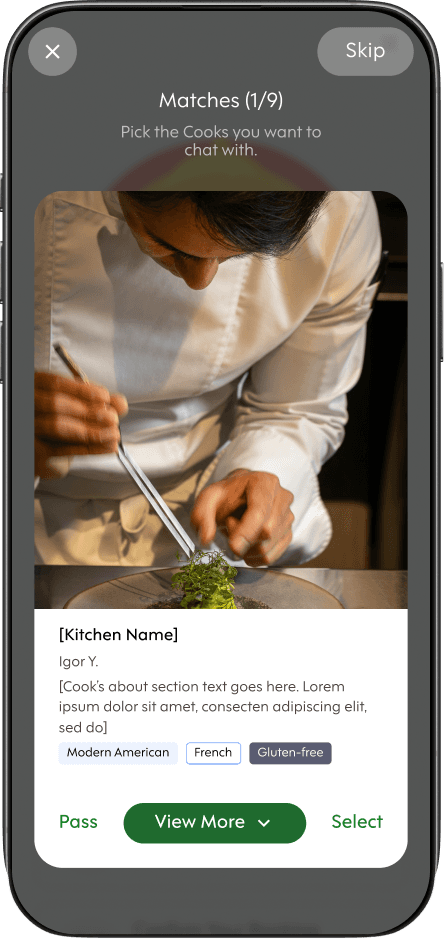
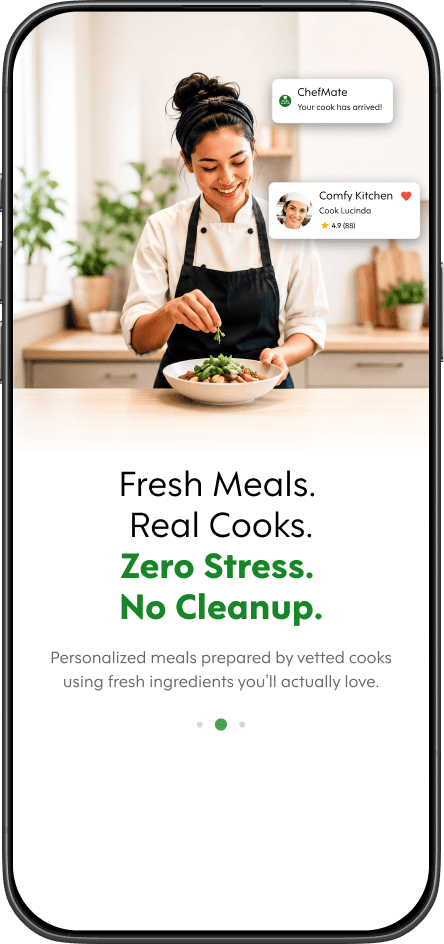
We designed a scalable household food services platform by applying behavioral research, service design, and product strategy to optimize both customer acquisition and provider enablement across the end-to-end marketplace experience. Built with the Flutter framework.

14+ citites nationwide

Home Cook
Marketplace

Join for the latest in music, exclusive content, and insider tips delivered right to your inbox.

117+ franchise locations nationwide

Home Cook
Marketplace

Join for the latest in music, exclusive content, and insider tips delivered right to your inbox.

117+ franchise locations nationwide

TEAM

Role: Senior Designer & Strategist
Timeline: 4 Weeks

Team Composition:
(onshore + offshore support)
• 1 Senior UX/UI Designer & Product Strategist (self)
• 4 Front-End Developers
• 1 Scrum Master
• 1 Backend Developer

MY CONTRIBUTIONS

Ethnographic Research • UX Research • UX Strategy • Service Design • Journey Mapping • Persona Development (10 total) • Brand Strategy • Brand Renaming Analysis • Logo Design • Experience Ecosystem Design • Illustration Design • Information Architecture • UX Writing • Interaction Design • UI Design • Design Systems • Growth Experience Design • Admin Tooling • Developer Handoff • QA Support • Cross-Functional Facilitation

Week 1:
Discover & Define

  • Stakeholder interviews and requirement gathering

  • Competitive analysis and market landscape assessment

  • Qualitative UXR and behavioral analysis

  • Ethnographic research into cook and customer behaviors

  • Service model evaluation and marketplace benchmarking

  • User interviews and insight synthesis

  • JTBD framing and opportunity mapping

  • Persona development and segmentation

  • User journey mapping (UJM) and pain point analysis

  • Experience principles and success metric definition

Week 2:
Strategy & Brand Positioning

  • Brand discovery workshops

  • Naming exploration and renaming analysis

  • Conflict resolution and alignment across naming directions

  • ICP identification and demographic prioritization

  • Conversion psychology analysis

  • Messaging architecture and positioning strategy

  • Value proposition definition

  • Feature prioritization and roadmap planning

  • Information architecture and navigation systems

Week 3:
Experience Design & Validation

  • Low- and high-fidelity wireframes

  • Mobile app UX/UI design

  • Empty states and behavioral onboarding

  • Trust and policy affirmation flows

  • Chat and booking interaction models

  • Notification systems

  • Self-promotion and growth tooling for cooks

  • Web admin dashboard architecture

  • Design critiques and iterative validation

Week 4:
Delivery & Execution

  • Cross-functional collaboration with FE + BE teams

  • Sprint support and requirement clarification

  • Edge case and state documentation

  • Interaction specifications

  • Design refinements and prioritization

  • QA Testing support

  • Go-to-market experience support

Week 5+ :
Social Media Advertising

(coming soon)

Week 8+ :
Feedback Loops

(coming soon)

DEFINITION PHASE

PERSONAS & UJM

PERSONAS & UJM

PERSONAS & UJM


I synthesized behavioral research into personas and user journey maps to uncover motivations, friction points, and unmet needs across the end-to-end experience. These insights informed experience strategy, prioritized opportunity areas, and aligned product decisions with user behavior and business goals.

BRAND RENAMING ANALYSIS

GOODBYE CHEFLY

GOODBYE CHEFLY

GOODBYE CHEFLY

USPTO REGISTRY CONFLICT

Midway through the project, we identified a critical business constraint: the original brand name, Chefly, presented a trademark risk due to overlap with a direct competitor operating in the meal prep and meal kit space. Rather than treating this as a mere naming exercise, I reframed it as a strategic branding opportunity.

RESEARCH-RELIANT CONFIDENCE

I led a structured research study for brand renaming grounded in competitive analysis, trademark feasibility, positioning strategy, linguistic evaluation, and target ICP resonance testing. Through audience-fit scoring, conversion potential analysis, memorability testing, and emotional brand perception mapping, we evaluated naming directions against the expectations of our highest-value customer segments.

UNEXPECTED OUTCOME

The outcome was a stronger, more defensible brand direction that better reflected the product’s premium in-home service model while reducing market confusion and creating a clearer path for acquisition, trust, and long-term differentiation.

DESIGN WINS

SCREEN PLAY

SCREEN PLAY

SCREEN PLAY


My design priorities focused on strengthening usability and operational efficiency by reducing unnecessary effort, increasing user confidence, accelerating time-to-value, and improving engagement across critical product journeys.


Ultimately, I leveraged current location and predictive interaction patterns to decrease manual input and accelerate task execution.

Interaction Simplification

Simplified address entry and location selection to minimize mental effort and help users complete tasks with less friction and faster decision-making.

Behavioral Enablement

Designed the experience to guide users toward successful task completion through contextual actions, reduced friction, and clear affordances at moments of intent.

Experience Continuity

Read inspiring stories from our community of artists, listeners, and industry professionals.

Information Hierarchy

Prioritized the most relevant actions first while revealing secondary options only when needed to reduce overwhelm and support focused completion.

Error Prevention

Surfaced previously used addresses and clear location cues so users could recognize information instead of remembering and manually re-entering it.

Decision Optimization

Restructured the journey around user intent to shorten completion paths, improve efficiency, and create a more seamless end-to-end experience.

DETAILS PAGES

DETAILS PAGES

DETAILS PAGES

To maximize sales potential, the designs focused on increasing dish discoverability, reduced decision abandonment, strengthened booking confidence, and supported higher conversion from browsing to meal selection.

Information Hierarchy

Structured dish information around the user’s evaluation sequence—visual appeal, trust signals, dietary fit, then decision actions—to reduce scanning effort and accelerate selection.

Decision Confidence Design

Combined ratings, prep expectations, ingredient transparency, and allergen visibility to reduce uncertainty and support faster, higher-confidence meal decisions.

Experience Continuity

Created a seamless transition between discovery, evaluation, and selection to preserve user flow across the booking journey.

Progressive Disclosure

Balanced richness with simplicity by surfacing essential information first while keeping deeper details accessible only when needed.

Conversion-Oriented UI

Designed persistent selection controls and minimized competing actions to maintain momentum from exploration to booking intent.

Trust Signal Architecture

Integrated social proof, dietary indicators, and operational expectations directly into the interface to increase perceived quality and reduce decision hesitation.


SELF-PROMOTION TOOLS


SELF-PROMOTION TOOLS


SELF-PROMOTION TOOLS

To enable cooks, designs focused on lowering customer acquisition dependency, increasing organic referral potential, expanding marketplace supply visibility, and creating scalable growth loops through provider-led distribution.

Provider Empowerment Design

Created embedded growth tools that enabled cooks to market themselves independently while keeping acquisition and transactions connected to the platform ecosystem.

Network Effect Enablement

Turned every cook into a distributed acquisition channel by introducing shareable, downloadable booking assets that expanded marketplace reach organically.

Experience Continuity

Created a seamless transition between discovery, evaluation, and selection to preserve user flow across the booking journey.

Conversion-Centered Distribution

Reduced the path from discovery to booking by transforming offline and social interactions into immediate, scannable conversion opportunities.

Cross-Channel Experience Design

Extended the platform experience beyond the app by creating portable touchpoints that maintained consistent branding and service continuity.

Behavioral Activation Systems

Encouraged provider participation and self-promotion through low-effort, high-visibility tools that increased perceived ownership and platform investment.

CONVERSATION DESIGN

CONVERSATION DESIGN

CONVERSATION DESIGN

For our specific user base, I reframed messaging as a transactional service layer rather than a communication tool by embedding quotes, negotiation, booking decisions, and resolution pathways directly into the conversation flow. Structured conversation architecture reduced ambiguity and enabled users to complete decisions without leaving context.

Resultantly, these were designed to reduce operational friction, shorten time-to-decision, increase booking recovery opportunities, and create a scalable communication framework that supports higher conversion and stronger marketplace trust.

Embedded Transactional Decision-Making

Integrated booking, quoting, negotiation, and resolution flows directly into conversation threads to reduce context switching and support faster service coordination.

Trust-Building Conversational UX

Designed transparent system states, structured message hierarchy, and visible transaction outcomes to reduce ambiguity and strengthen confidence between both parties.

Service Recovery & Retention Patterns

Converted failed or declined interactions into recovery opportunities through guided next actions, preserving engagement and reducing abandonment after friction points.

SUCCESS PRAISE

SUCCESS PRAISE

SUCCESS PRAISE

To foster a strong sense of belonging and community, I designed celebratory success states as behavioral reinforcement loops to convert onboarding completion into continued platform investment. By pairing emotional reward with a clear next-step CTA, the experience increased perceived momentum, strengthened user confidence, and reduced post-completion drop-off.

To foster a strong sense of belonging and community, I designed celebratory success states as behavioral reinforcement loops to convert onboarding completion into continued platform investment. By pairing emotional reward with a clear next-step CTA, the experience increased perceived momentum, strengthened user confidence, and reduced post-completion drop-off.

Positive Reinforcement Loops

Introduced celebratory feedback and visible progress cues to reinforce achievement moments, increase perceived momentum, and encourage continued platform completion.

Behavioral Momentum Design

Reduced post-completion drop-off by immediately directing users toward the next high-value action, sustaining engagement through clear progression pathways.

Emotional Experience Design

Applied delight, visual reward mechanisms, and encouraging microcopy to transform transactional onboarding into a memorable, confidence-building brand experience.

AFFIRMATIONS

AFFIRMATIONS

AFFIRMATIONS

To ensure brand compliance, I designed intentionally tactful behavioral onboarding and affirmation experiences that translated brand values into repeatable service standards. Recognizing this as the primary training experience for cooks representing the entire platform, I prioritized clarity, motivation, and expectation-setting to enable consistent, high-quality customer experiences at scale.

Trust-Centered Visual Hierarchy

Trust-Centered Visual Hierarchy

Structured information with progressive emphasis, iconography, and intentional spacing to make policies feel approachable, increasing readability and reducing perceived complexity.

Structured information with progressive emphasis, iconography, and intentional spacing to make policies feel approachable, increasing readability and reducing perceived complexity.

Behavioral Commitment Design

Transformed passive policy acceptance into an active affirmation experience that reinforces accountability, expectation-setting, and stronger adherence to community standards.

Brand-to-Behavior Translation

Brand-to-Behavior Translation

Converted abstract brand values into clear, actionable service principles through thoughtful UI patterns, supportive microcopy, and emotionally reassuring interaction design.

Converted abstract brand values into clear, actionable service principles through thoughtful UI patterns, supportive microcopy, and emotionally reassuring interaction design.

EMPTY STATES

EMPTY STATES

EMPTY STATES

To playfully engage users and diminish cognitive load, I reimagined empty states as engagement opportunities by introducing playful visual feedback and inviting guidance that reduced abandonment, increased perceived progress, and motivated users toward activation.


Activation Architecture

We transformed empty states from dead ends into guided next steps by surfacing visible opportunities for profile completion and content creation. This reduces decision paralysis, increased perceived progress, and encouraged faster movement toward marketplace readiness.

Progressive Disclosure

I introduced staged guidance and lightweight visual scaffolding to help users understand what belongs in each section without overwhelming them upfront. By revealing actions contextually, the experience lowered mental effort and made setup feel achievable.

Behavioral Momentum Design

Used placeholder states, positive affordances, and visible growth cues to reinforce completion behavior and create a sense of investment early in the journey. This increased engagement potential by shifting users from passive browsing into active profile building and platform participation.

GTM PHASE

MARKETING WEBSITE (wip)

MARKETING WEBSITE (wip)

MARKETING WEBSITE (wip)


To ensure a successful go-to-market strategy, I synthesized ICP research and demographic insights into a targeted experience strategy that aligned messaging, content hierarchy, and conversion pathways to maximize engagement and customer acquisition.

COMPANION WEB APP

WEB ADMIN BACKOFFICE

WEB ADMIN BACKOFFICE

WEB ADMIN BACKOFFICE


Based on ICP research and demographic insights, I extracted the right strategy for a targeted experience that aligned messaging, content hierarchy, and conversion pathways to maximize engagement and customer acquisition.

Operational Visibility Design

Centralized platform health, booking operations, user management, and dispute resolution into a single decision environment to enable faster administrative oversight.

Decision Intelligence Architecture

Prioritized critical metrics, status indicators, and action pathways through structured hierarchy to support rapid operational decision-making.

Workflow Optimization

Reduced administrative overhead by streamlining high-frequency tasks into scalable workflows with fewer clicks and lower cognitive load.

System Governance Design

Created transparent operational controls that supported quality assurance, platform accountability, and consistent service execution across marketplace stakeholders.

Exception Management Framework

Designed for intervention efficiency by surfacing risks, bottlenecks, and operational anomalies before they escalated into customer-facing issues.

Scalable Platform Operations

Built flexible administrative infrastructure capable of supporting marketplace growth without proportionally increasing operational complexity.

BOOKING MG (wip)

BOOKING MG (wip)

BOOKING MG (wip)

This tab aimed to solve complexities in operational efficiency, reduced manual processing effort, improved booking resolution speed, and created scalable infrastructure to support marketplace growth without linear increases in admin workload.

Operational Command Center

Designed a centralized orchestration layer that consolidated booking oversight, exception handling, and lifecycle management into a single operational workspace. The interface prioritizes high-frequency actions and reduces administrative coordination overhead.

Decision Acceleration Framework

Structured filters, status segmentation, and progressive data hierarchy to support rapid triage and shorten time-to-action across large booking volumes. Critical information becomes immediately scannable without sacrificing operational depth.

Exception-Driven Workflow Design

Surfaced escalations, cancellations, and booking states through visual prioritization patterns to enable proactive intervention instead of reactive management. This reduced cognitive load while improving throughput for support and operations teams.

USER MG (wip)

USER MG (wip)

USER MG (wip)

Operational Visibility

Designed a management layer that surfaces the highest-value user signals first—onboarding progress, account health, verification status, disputes, and activity—so teams can identify bottlenecks and act without navigating multiple systems.

Scalable Administration

Structured user data into searchable, filterable, segmented workflows that reduce cognitive load and support efficient moderation as platform volume grows without proportional increases in operational effort.

Lifecycle Management Architecture

Created a unified oversight experience that supports the full user journey—from onboarding and verification to engagement monitoring and issue resolution—enabling faster decisions and more consistent platform governance.

PROMOTIONS & ADS (wip)

PROMOTIONS & ADS (wip)

PROMOTIONS & ADS (wip)

Growth Enablement Infrastructure

Designed an operational control layer that enables teams to manage promotions, campaigns, notifications, and app content from a single system—reducing dependency on engineering and accelerating go-to-market execution.

Campaign Orchestration & Governance

Structured campaign creation, scheduling, audience targeting, and status management into a centralized workflow that improves oversight, reduces launch friction, and supports controlled experimentation at scale.

Lifecycle Activation Design

Created an app management ecosystem that connects acquisition, engagement, retention, and reactivation touchpoints—turning administrative tooling into a measurable driver of marketplace growth and user adoption.

CUISINE MG (wip)

CUISINE MG (wip)

CUISINE MG (wip)

Taxonomy Governance

Designed a centralized content management system that gives teams direct control over cuisine visibility, categorization, ranking, and discoverability—creating a more intentional marketplace experience without requiring product releases.

Discoverability Optimization

Structured cuisine data through filtering, display order, popularity signals, and status controls to improve content relevance, reduce choice overload, and guide users toward higher-converting browsing paths.

Dynamic Marketplace Curation

Created scalable tooling that enables continuous optimization of culinary supply—allowing teams to promote seasonal offerings, balance marketplace demand, and adapt inventory strategy in real time.

This project reminded me that great UX isn’t only about reducing taps or increasing conversion—it’s about helping someone believe their vision is possible.

Throughout this process, I became deeply invested in both the client and the people she hoped to serve. I spent time understanding her ambitions, fears, and the experience she wanted customers and cooks to feel at every touchpoint. Somewhere along the way, this became more than a product exercise—I genuinely fell in love with her users and what this platform could unlock for them.


One of the moments I’m proudest of was facilitating the brand renaming exercise and positioning exploration. We navigated differing opinions, evaluated naming directions against target ICP psychology, conversion potential, and long-term brand equity, and worked through uncertainty until we found a name that felt strategically right and emotionally true to her audience.


By the end of the engagement, what stayed with me most wasn’t the screens—it was seeing her step into her business with confidence. She went from carrying an idea to feeling empowered to launch it like an empress: clear in her vision, proud of what she built, and excited to lead.


This project strengthened my belief that design is equal parts systems thinking, conflict resolution, psychology, and care. The strongest experiences are created when people feel heard—and I left this project feeling grateful that we built something meaningful together.


SPECIAL THANKS TO CORREN,
for the chance to make my first mobile app from end-to-end in 4 weeks. I will always remember this project as you were a delightful visionary to work with.

CONCEPT-TO-SHIPPED !

LEARNINGS

CONCEPT-TO-SHIPPED !

LEARNINGS

LEARNINGS

This project reminded me that great UX isn’t only about reducing taps or increasing conversion—it’s about helping someone believe their vision is possible.

Throughout this process, I became deeply invested in both the client and the people she hoped to serve. I spent time understanding her ambitions, fears, and the experience she wanted customers and cooks to feel at every touchpoint. Somewhere along the way, this became more than a product exercise—I genuinely fell in love with her users and what this platform could unlock for them.


One of the moments I’m proudest of was facilitating the brand renaming exercise and positioning exploration. We navigated differing opinions, evaluated naming directions against target ICP psychology, conversion potential, and long-term brand equity, and worked through uncertainty until we found a name that felt strategically right and emotionally true to her audience.


By the end of the engagement, what stayed with me most wasn’t the screens—it was seeing her step into her business with confidence. She went from carrying an idea to feeling empowered to launch it like an empress: clear in her vision, proud of what she built, and excited to lead.


This project strengthened my belief that design is equal parts systems thinking, conflict resolution, psychology, and care. The strongest experiences are created when people feel heard—and I left this project feeling grateful that we built something meaningful together.


SPECIAL THANKS TO CORREN,
for the chance to make my first mobile app from end-to-end in 4 weeks. I will always remember this project as you were a delightful visionary to work with.

Create a free website with Framer, the website builder loved by startups, designers and agencies.